Small World Phenomenon
Open full-size illustration →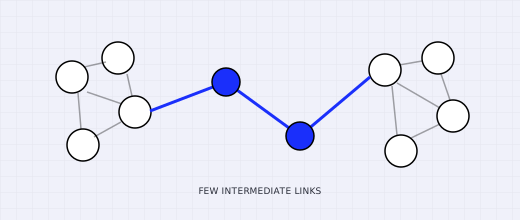
The small-world phenomenon is the finding that most people in a large network are connected to each other through only a small number of intermediate links.
The idea
Even in huge social, professional, or digital networks, the typical path length between any two nodes is surprisingly short. The idea is best known through the “six degrees of separation” experiments. Stanley Milgram’s 1960s letter-forwarding studies suggested most people in the U.S. could reach a stranger through a chain of about six acquaintances. A mostly tight-cluster network becomes a “small world” once a few long-range links between distant clusters appear. Duncan Watts and Steven Strogatz formalized that structure.
When to use it
- Explaining why information, trends, or diseases spread through a population unexpectedly fast
- Understanding why a handful of well-placed connections matter more than raw network size
- Reasoning about how quickly an introduction or opportunity can reach someone outside your circle
How to apply it
- Look for the few long-range or bridging connections in a network rather than only its dense local clusters.
- When you need to reach someone far outside your circle, expect a handful of well-chosen introductions.
- Recognize that adding or removing a few bridging links can change how fast something spreads through the network.
Watch out for
- “Six degrees” is a popularized shorthand from limited experiments, not an exact law that applies everywhere.
- A short average path length does not mean every path is easy to find or use. A chain can exist without anyone being able to activate it.
Related models
- Centrality. Measures which nodes matter most within this kind of network structure.
- Brokerage and Closure. Describes the bridging positions that create small-world short paths.
- Network Building. A practical approach to positioning yourself well within such a network.
Sources
Stanley Milgram, “The Small World Problem” (Psychology Today, 1967); Duncan J. Watts and Steven H. Strogatz, “Collective dynamics of ‘small-world’ networks” (Nature, 1998).