Scientific Method
growing Last tended 2025-07
Open full-size illustration → 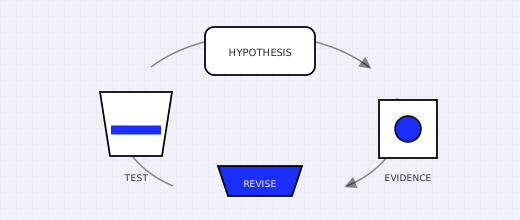
The scientific method is the disciplined process of forming a testable hypothesis, gathering evidence to test it, and revising or discarding the hypothesis based on the result.
The idea
Observation raises a question; a hypothesis proposes a possible explanation; predictions are derived from the hypothesis; experiments or further observation test those predictions; and the hypothesis is revised, abandoned, or provisionally accepted based on the outcome. The cycle repeats, and no hypothesis is ever finally “proven” — it only survives repeated attempts to disprove it, or it doesn’t.
When to use it
- Testing whether a belief, product change, or business assumption actually holds up
- Separating opinion or intuition from something that has been checked against evidence
- Designing any experiment, however informal, where you want the result to actually change your mind
How to apply it
- State the hypothesis precisely enough that it could be shown wrong.
- Predict what you’d observe if the hypothesis is true, and what you’d observe if it’s false.
- Run the experiment or gather the evidence, controlling for other explanations where possible.
- Update the hypothesis based on the result, rather than the result based on the hypothesis.
Watch out for
- Designing experiments that can only confirm the hypothesis, never disconfirm it
- Treating a single result as final rather than provisional
- Letting the desired outcome bias what counts as evidence
Related models
- Falsifiability — the criterion a hypothesis must meet to be tested this way.
- Controlled Experiment — the core tool for testing a hypothesis.
- Probabilistic Thinking — most results should update confidence, not deliver certainty.
Sources
Karl Popper, The Logic of Scientific Discovery (1934/1959); the scientific method as generally taught in the philosophy of science.