Probabilistic Thinking
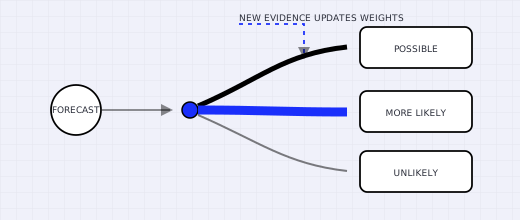
Probabilistic thinking means estimating the likelihood of different outcomes rather than assuming any single prediction is certain, and updating those estimates as new information arrives.
The idea
Most real-world questions do not have a single guaranteed answer. They have a range of possible outcomes, each with a different chance of happening. Probabilistic thinkers assign rough odds to outcomes instead of thinking in binary “will happen / won’t happen” terms, and they revise those odds as evidence comes in. Charlie Munger listed this among the core mental models worth carrying in a decision-maker’s “latticework,” alongside basic ideas from statistics such as expected value and base rates.
When to use it
- Forecasting outcomes with incomplete information (business bets, investments, planning)
- Weighing risks where the cost of being wrong varies by outcome
- Evaluating claims or predictions made with false certainty
How to apply it
- List the plausible outcomes, including ones you do not expect.
- Assign a rough likelihood to each, using base rates where available.
- Weigh outcomes by both probability and impact (expected value). Probability alone is not enough.
- Update your estimates as new evidence arrives instead of anchoring on the first guess.
Watch out for
- False precision. A rough probability is still more honest than false certainty. Do not over-trust a specific number.
- Ignoring base rates in favor of a compelling story (a common source of misjudgment).
- Ignoring how a single bad outcome, even if unlikely, can be catastrophic (fat-tail risk).
Related models
- Decision Making on Short, Medium, and Long Term. Probabilistic thinking feeds into weighing choices across time horizons.
- First Principles. Another core reasoning tool from the same mental-models toolkit.
- Regret Minimization. A complementary way to decide under uncertainty.
Sources
Charlie Munger’s talks on a “latticework of mental models,” collected in Poor Charlie’s Almanack.