Objectives and Key Results (OKRs)
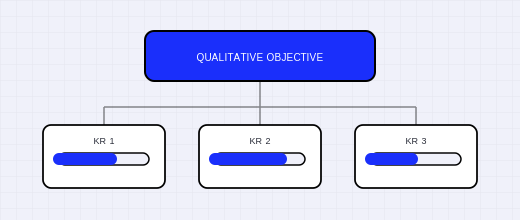
Objectives and Key Results (OKRs) is a goal-setting framework used to align a company’s strategy and track its execution.
The idea
What are OKRs
Objectives and Key Results (OKRs) are quarterly, yearly, and sometimes monthly objectives. They lay out a company plan to execute strategy, so the goals and how to achieve them are clear for everyone in the company. Often, this means OKR’s are shared throughout a company transparently.
Objectives say what the company aims to do. Key results are the metrics that show whether the objective was achieved. They are how we measure success.
The OKR methodology was pioneered by Andy Grove at Intel. John Doerr wrote a book about OKR’s and their power. Superpowers, as he calls them.
OKRs are what is different
The OKRs are what initiatives a company is focusing on in a given quarter specifically. The most important work is things that happen every quarter. These tend to have a more operational nature. Things that happen every quarter are measured with Key Performance Indicators (KPI’s). Part of the OKRs will be KPI’s or cause changes in KPIs.
How to apply it
The superpowers of OKR’s
OKRs have four superpowers:
- Focus
- Alignment
- Tracking
- Stretch. See the book for the fuller explanation.
Less is more. “A few extremely well chosen objectives make it very clear to what we say ‘yes’ and to what we say ‘no’”. Three objectives is good. Five is the absolute maximum, for a company, a team, or an individual.
Set goals from the bottom up. That promotes engagement. Teams and individuals should set about 50% of their own OKRs, in consultation with managers.
Do not dictate OKRs. They are a cooperative social contract for priorities and progress.
Stay flexible. There is no need to stick to objectives if the climate has changed.
Dare to fail. Failure is progress. Some operational objectives must be met in full, such as uptime of 99.95%. Aspirational objectives must be stretch goals.
OKRs are a tool, not a weapon. Do not link them to performance reviews. Unlinking them encourages risk taking and prevents sandbagging.
Be patient and resolute. Expect trial and error. Be agile and adapt. You will get better at it.
It’s best to not couple OKR’s to performance reviews. Do not use them for compensation review or to give performance feedback. For example, people will start sandbagging instead of setting stretch goals if you do.
At least around 50% of OKR’s should be set bottom-up. Also, when starting with OKR’s, expect to require 4-5 quarters of OKR setting to get the hang of it.
- “What” and “How”
- Quarterly or Monthly
- Public and transparent
- Bottom-up or Sideways (~50%)
- Mostly divorced from compensation
- Aggressive and aspirational (as opposed to risk averse)
OKRs are stretch goals by default
OKRs should be ambitious but achievable. Stretch goals. If you achieve less than 60% of your KR, it may not have been achievable. If you are regularly achieving 100% of your KRs, your goals may not be ambitious enough.
Aim for an achievement rate of 60-70%.
Shared objectives
If there is something important that requires two (or more) parts of the organization, all leaders involved should share the same, or a similar objective. Key results should not conflict so each can achieve things within their own sphere of control. This helps with accountability.
Related models
- North Star. Sets the longer-term direction that OKRs execute toward.
- Big Hairy Audacious Goal (BHAG). A more aspirational, longer-horizon goal type.
- SMART Goals. An alternative goal-setting format for individual objectives.