Metacognition
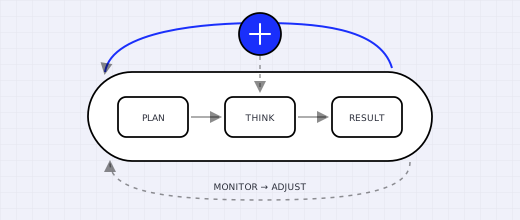
Metacognition is awareness and understanding of your own thought process. You step back and ask, “How am I thinking about this, and is it working?” You ask that instead of staying absorbed in the thinking itself.
The idea
Metacognition operates one level above ordinary cognition. It has two main parts. Knowledge of your own cognitive processes includes knowing what you are good at and which strategies you tend to use. Regulation of those processes includes planning an approach, monitoring progress, and adjusting when something is not working. Reading a chapter is ordinary thinking. Noticing midway that you are not retaining it, and switching strategy, is metacognition.
When to use it
- Learning a new skill or subject, to check whether your study method is actually working.
- Making a difficult decision, to notice which biases or assumptions might be shaping your judgment.
- Solving a hard problem, to recognize when the current approach has stalled and a different one is needed.
How to apply it
- Before starting a task, plan your approach and predict how it will go.
- While working, periodically check whether this is working, and how you know.
- Afterward, review what worked and what didn’t, and note it for next time.
Watch out for
- Overthinking to the point of paralysis; metacognition should inform action, not replace it.
- Confusing confidence in your thinking with accuracy. Metacognitive judgments can themselves be wrong.
Related models
- Learning How to Learn. Applies metacognition specifically to study and skill acquisition.
- Chunking. A technique metacognitive awareness can help you recognize you need.
- Working Memory. One of the cognitive limits metacognition helps you work around.
Sources
The term was popularized by developmental psychologist John H. Flavell in the 1970s.