Meta Tool Usage and Creation
Open full-size illustration →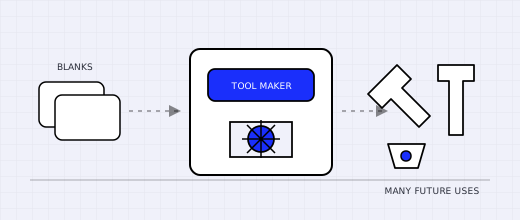
A tool solves a problem once. A meta-tool is a tool for making tools. It solves a whole class of future problems, because every tool it helps you build keeps that advantage. Meta tool usage and creation is the practice of noticing when you’re about to build a one-off solution and asking whether building the thing that builds the solution is worth the extra investment.
The idea
Most useful capability is layered. A hammer is a tool. A forge that makes hammers is a meta-tool. A factory that makes forges is one level higher still. Each layer takes more upfront effort but pays off across every future use. The same pattern shows up in software (a script vs. a code generator vs. a framework), in organizations (a process vs. a process for designing processes), and in personal skill-building (learning a fact vs. learning how to learn).
When to use it
- You notice you’re solving the same kind of problem repeatedly by hand.
- The cost of building a reusable tool is small relative to how often it will be reused.
- You are building for a team or a future version of yourself. Today’s task is only part of the use.
How to apply it
- Before solving a problem directly, ask whether a slightly more general version of the solution would cover future variants too.
- Estimate the break-even point. How many future uses justify the extra time spent making the tool reusable?
- Build the minimal meta-tool, use it once yourself, then refine it based on that use before generalizing further.
Watch out for
- Over-engineering a meta-tool for a problem that only ever occurs once.
- Meta-tools that are harder to learn than the problems they solve.
- Investing in tool-building as procrastination on the actual task.
Related models
- Technium. The self-reinforcing system of technology building on technology.
- Compound Interest. The same payoff-over-time logic that makes meta-tools pay off.
- Learning How to Learn. The personal-skill equivalent of meta-tool creation.
- Procrastination. Tool-building can become procrastination on the actual task.