Kaizen
mature Last tended 2025-07
Open full-size illustration → 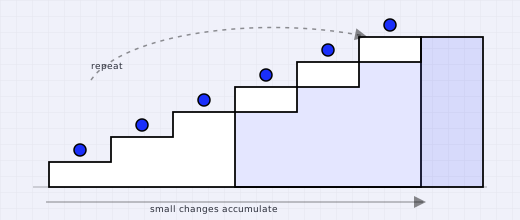
Kaizen is the Japanese practice of continuous, incremental improvement, carried out by everyone in an organization every day, rather than left to a specialist team or an occasional big overhaul.
The idea
It is continuous improvement, driven by everyone, everywhere, every day.
- Know your customer. Identify their interests so you can improve their experience and create value for them.
- Let it flow. Target zero waste. Everyone in the organization works to create value and eliminate waste.
- Go to Gemba. Value is created where the work actually happens, so go there and follow the action. Do not manage the work only from a distance.
- Be transparent. Speak with real data. Performance and improvements should be tangible and visible to everyone.
- Empower people. Set shared goals for teams and give them the system and tools to reach them.
The philosophy is closely tied to the Toyota Production System and was popularized as a management approach in Masaaki Imai’s book Kaizen: The Key to Japan’s Competitive Success.
When to use it
- Refining a manufacturing or operational process step by step
- Running team retrospectives that end in small, concrete changes
- Building a personal practice of steady skill or habit improvement
How to apply it
- Go to Gemba. Observe the place where the work actually happens
- Find a specific piece of waste or friction, backed by real data, not opinion
- Make one small change and test it
- Standardize what works, then repeat the loop
Watch out for
- Treating Kaizen as a one-off improvement event rather than a sustained daily habit
- Skipping Gemba and trying to improve a process from data and meetings alone
- Relying only on small improvements when the underlying system itself needs a larger rethink
Related models
- Design for Lean Six Sigma. A related Lean/Six Sigma improvement approach.
- Lean Startup. Shares Kaizen’s roots in Lean thinking and iterative improvement.
- Deliberate Practice. The individual-skill analogue of continuous improvement.
Sources
Masaaki Imai, “Kaizen: The Key to Japan’s Competitive Success” (1986); Kaizen.