Identify Root Causes
Open full-size illustration →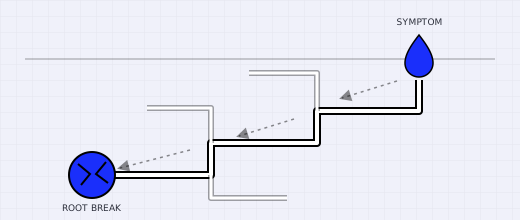
Identifying root causes means tracing a problem back to the underlying condition that produces it, instead of stopping at the most visible symptom.
The idea
Most problems show up as symptoms. The symptom is the thing that is obviously wrong. Fixing the symptom can make the problem disappear temporarily, but if the underlying cause is untouched, it tends to resurface in the same or a different form. A root cause is the point in the chain of events where an intervention would actually prevent the problem, as opposed to a proximate cause, which is simply the last event before the outcome. Treating symptoms without finding that point is why the same failure keeps returning under a slightly different name.
When to use it
- A problem keeps recurring despite repeated fixes
- Deciding where in a process to invest effort so the fix actually sticks
- Debugging, incident reviews, and postmortems where a superficial fix would leave the real issue in place
How to apply it
- Describe the problem precisely, separating the symptom from your assumptions about its cause
- Ask “why” repeatedly (the “5 Whys” technique), following each answer back one more step
- Look for the point where a change would have prevented the problem. Masking the symptom is not that point
- Test the hypothesis before committing to a fix. A plausible root cause is not a confirmed one
Watch out for
- Stopping too early and mistaking a proximate cause for the root cause
- Complex problems often have multiple contributing causes, not a single root
- Root-cause thinking can become an excuse for inaction if it’s used to defer any fix until “the real problem” is found
Related models
- Root Cause Analysis. The structured process for applying this idea.
- Root Cause vs Proximate Cause. The distinction this model depends on.
- Problem Definition. Getting the problem statement right before searching for its cause.
Sources
The “5 Whys” technique, developed within the Toyota Production System.