Forgetting Curve and Spaced Repetition
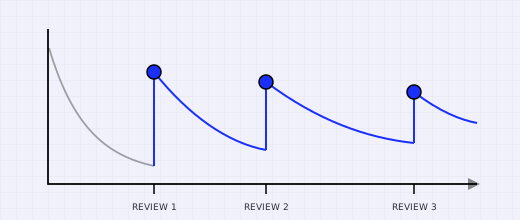
The forgetting curve describes how newly learned information fades over time unless it is reactivated; spaced repetition is the countermeasure of reviewing material at increasing intervals to keep it in long-term memory.
The idea
Hermann Ebbinghaus’s memory experiments showed retention drops steeply soon after learning and then levels off. Each review flattens the curve and pushes the next point of significant forgetting further out, which is why spaced review is more efficient for long-term retention than repeating material in one sitting (massed practice, i.e. cramming). The timing matters. Reviewing too early wastes effort on something you still remember. Reviewing too late means you have already lost it and have to relearn it from scratch.
When to use it
- Studying for an exam or learning material you need to retain for months.
- Onboarding or training content that needs to stick beyond the session.
- Any memorization task, such as vocabulary, facts, or procedures.
How to apply it
- Review new material shortly after first learning it.
- Space out subsequent reviews further apart each time.
- Use a spaced-repetition system (flashcard app or similar) to schedule reviews automatically.
- Prioritize reviewing items you are close to forgetting over ones you already know well.
Watch out for
- Passive re-reading is much weaker than active recall (testing yourself).
- Cramming feels productive short-term but decays fast.
- Review queues can pile up without a system that adjusts intervals per item.
Related models
- Learning How to Learn. The broader skill this technique supports.
- Deliberate Practice. Structured practice that pairs well with spaced review.
- Chunking. Breaking material into units that are easier to encode and recall.
Sources
Hermann Ebbinghaus, Über das Gedächtnis (1885); spaced repetition popularized by systems such as SuperMemo and Anki.