First Principles
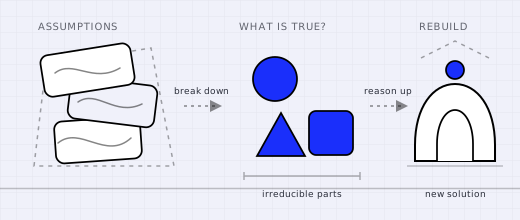
First-principles thinking means breaking a problem down into its most basic, verifiable truths and reasoning back up from there, rather than reasoning by analogy to how it has always been done.
The idea
Most reasoning is by analogy. We do things a certain way because that’s how they’ve always been done, or because someone else does it that way. First-principles thinking strips away inherited assumptions and asks what is actually, verifiably true about the problem itself.
Aristotle described a first principle as “the first basis from which a thing is known.” Applied practically, that means decomposing a problem into its fundamental components and questioning every assumption layered on top. Rebuild a solution using only what can be independently verified, and leave the inherited approach behind.
Elon Musk popularized the approach with his battery-cost example. Rather than accept “battery packs are expensive because they’ve always been expensive,” he priced out the raw materials at commodity market rates. The materials were cobalt, nickel, aluminium, and carbon. The material floor came in far below the market price of a finished pack, exposing the gap as an opportunity rather than a fixed cost. He applied the same reasoning at SpaceX, pricing a rocket by its raw materials and components rather than the industry’s going rate.
When to use it
- A problem seems expensive “because that’s just how it’s always been done”
- An industry or team seems anchored on outdated assumptions
- A cost or constraint is treated as fixed just because of precedent
- You want to innovate rather than iterate on an existing solution
How to apply it
- State the current belief or approach explicitly.
- Break it down into fundamental, verifiable components.
- Discard assumptions that are not fundamental. That includes norms, “best practices,” and sunk costs.
- Price or measure each part from first sources. Use commodity markets, raw manufacturing costs, or physics.
- Reason back up from the fundamentals to a new approach.
- Test the new approach against reality, not convention.
Watch out for
- It is slow. Reserve it for problems where convention may be wrong or costly
- Easy to mistake a deeply-held assumption for a fundamental truth
- Misidentified “fundamentals” can produce worse conclusions than analogy would
- Shallow decomposition produces a false floor that ignores real engineering and assembly costs
Related models
- Second Order Effect. Once first principles gives you a new approach, second-order thinking checks what follows from it.
- Simplifying. First principles is one route to simplifying a problem down to its essentials.
Sources
- Aristotle, Posterior Analytics, on first principles as the basis of knowledge.
- Elon Musk, TED2013 interview with Chris Anderson, on the battery-pack material-cost example.
- Tim Urban, “The Cook and the Chef: Musk’s Secret Sauce,” Wait But Why (2015).