Falsifiability
Open full-size illustration →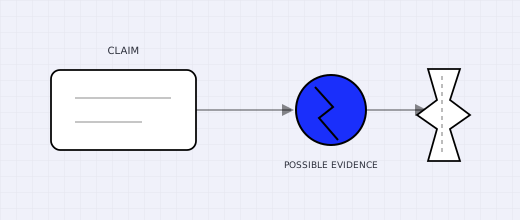
Falsifiability is Karl Popper’s criterion for what makes a claim scientific. It must be possible, at least in principle, to design an observation or experiment that could prove the claim wrong.
The idea
Popper argued that science advances by exposing theories to tests that could refute them. Accumulating confirmations is not the method. A theory that survives repeated, genuine attempts at refutation earns more confidence. A theory compatible with every possible outcome explains nothing. Falsifiability is a demarcation criterion. It separates scientific claims from unfalsifiable ones. Unfalsifiable claims may still be meaningful. They are not scientific in this sense.
When to use it
- Evaluating whether a claim, theory, or forecast is testable, or just unfalsifiable rhetoric
- Designing experiments or metrics that could disprove your hypothesis, instead of only confirming it
- Spotting pseudoscience or unfalsifiable business and investment narratives (“it will work eventually”)
How to apply it
- State the claim precisely enough that you can specify what evidence would prove it false.
- Actively look for that disconfirming evidence rather than only confirming evidence.
- Treat a theory that explains every possible outcome as a red flag, not a strength.
Watch out for
- Confusing “hard to test right now” with “unfalsifiable in principle”
- Motivated reasoning that reframes disconfirming evidence as consistent with the theory after the fact
- Over-applying the criterion to non-scientific domains (ethics, aesthetics) where it does not apply directly
Related models
- Scientific Method. Falsifiability is a core requirement within the scientific method.
- Controlled Experiment. One practical way to expose a claim to falsification.
Sources
Karl Popper, The Logic of Scientific Discovery (1934/1959).