Design for Lean Six Sigma
Open full-size illustration →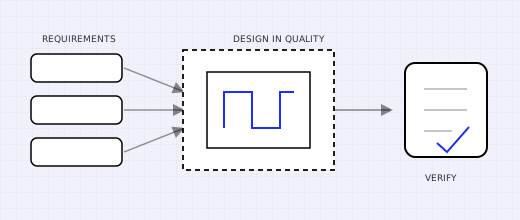
Design for Lean Six Sigma (DFLSS) applies Lean and Six Sigma principles to the design of a new process, product, or service, rather than to improving one that already exists.
The idea
Six Sigma’s classic DMAIC cycle (Define, Measure, Analyze, Improve, Control) is built for optimizing an existing process. DFLSS instead uses a “design-first” cycle, commonly DMADV (Define, Measure, Analyze, Design, Verify), because there is no current process to measure and improve. The goal is to build in quality, efficiency, and low variation from the start, rather than fix it in afterward. It combines Lean’s focus on eliminating waste with Six Sigma’s focus on reducing defects and variation.
When to use it
- Launching a genuinely new product, service, or process, where no baseline process exists yet
- Situations where retrofitting quality into an existing process (via DMAIC) would be more costly than designing it in
- Projects with a clear customer requirement that needs to be translated into a robust design
How to apply it
- Define the project goals and customer requirements.
- Measure and translate requirements into measurable design specifications.
- Analyze options and identify the design that best meets the requirements.
- Design the process or product in detail.
- Verify the design performs as intended, often through a pilot.
Watch out for
- It requires more upfront rigor and data than an ad-hoc design process, which can feel slow for fast-moving teams
- It is easy to confuse with DMAIC; the two apply to different situations (new design vs. existing process)
- Like other Six Sigma tools, it can become bureaucratic if applied to problems too small to justify the overhead
Related models
- DMAIC. The equivalent cycle for improving an existing process rather than designing a new one.
- Kaizen. A complementary philosophy of continuous, incremental improvement.
- Lean Startup. A lighter-weight approach to validating a new product design.
Sources
Six Sigma / Lean Six Sigma methodology literature (Motorola, General Electric); commonly documented as the DMADV cycle.