Decision Making on Short, Medium, and Long Term
Open full-size illustration →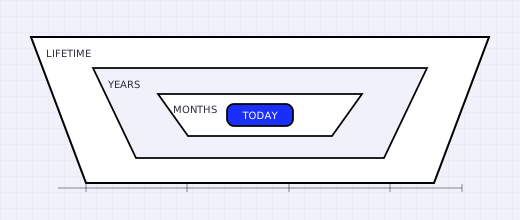
A chain of mental models, one per decision time horizon, from lifetime choices down to daily tasks.
The idea
We can follow a similar chain of mental models when making decisions.
How to apply it
Use Regret Minimization for long-term decisions. Choose whichever option you’ll most regret not having done when looking back at the end of your life. This is how you optimize for long-term happiness. When you’re done this post, see my other post on choosing your career path using Regret Minimization.
Use Pareto’s Principle for medium-term decisions. To maximize ROI, preferentially invest in the top 20% of inputs.
This is how you optimize each year or decade of your life. Personally, this is how I decide who to spend time with, which skills to hone, and which businesses to build.
- Use ICE for short-term decisions. When you face many options that need a ranking, score each from 1 to 10 on three variables.
- The positive impact it would have if it succeeds.
- The confidence you have that it will succeed if you try it.
- How easy it would be to try it.
For each option, average its three numbers to get its ICE score. Then order all your options by their ICE scores. Options at the top of your list will have the highest expected value and should be given priority.
This is how you plan your life on the timescale of weeks or months. This is how my business decides which growth projects to pursue.
- Use the Eisenhower Matrix for day-to-day decisions. Make a 2x2 grid with axes labeled “Important” and “Urgent.” Bucket your daily tasks into the four quadrants and prioritize them in this order. Do important and urgent first, then important but non-urgent, then unimportant but urgent, then unimportant and non-urgent.
Refer to this image. In Anders Ericsson’s words, “Your skill in anything is based on the number and quality of mental representations you have for the skill. For example, chess players improve most by studying and challenging themselves with expert matches. They build mental representations of others’ games, which help them improve much more than simply playing more games.”
Related models
- Regret Minimization. The long-term layer of this chain.
- Prioritization 80/20 Pareto. The medium-term layer of this chain.
- ICE Framework. The short-term layer of this chain.
- Eisenhower Matrix. The daily layer of this chain.
- Deliberate Practice. The closing note on skill-building relates to this.