Contrast Misreaction
Open full-size illustration →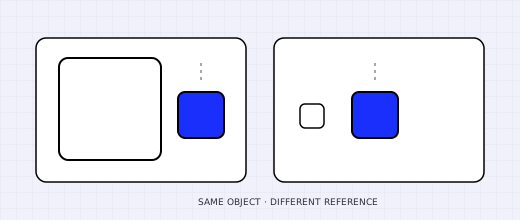
Contrast misreaction is the tendency to judge something relative to a recent or nearby reference point rather than on its own absolute terms, distorting perception of its true value or size.
The idea
The mind evaluates most things by comparison rather than by measuring them in isolation. A price looks cheap or expensive depending on what was shown right before it. A change looks large or small depending on the starting point. Because this happens automatically, people can be steered toward misjudging a situation simply by controlling what it’s contrasted against. In sales, that means showing an expensive item first. In negotiation, that means opening with an extreme anchor.
When to use it
- Reviewing a decision influenced by a “before” reference point, such as a previous price, a first offer, or a prior version
- Designing or evaluating pricing and comparisons that might be exploiting contrast rather than informing
- Negotiating, where the first number anchors everything that follows
How to apply it
- Notice what reference point is being used, explicit or implicit, before judging something as good, bad, big, or small
- Ask what it would look like against a neutral or absolute baseline instead
- In negotiations or pricing, be deliberate about what gets shown first, since it sets the contrast for everything after
Watch out for
- Contrast effects are subtle and hard to notice in the moment, even when you know about the bias
- Sequential comparisons compound contrast errors more than a single side-by-side comparison
- Marketers and negotiators use contrast deliberately, so awareness matters most when someone else controls the reference point
Related models
- Cognitive biases. Contrast misreaction is one of Charlie Munger’s catalogued psychological tendencies
- Deprival-superreaction. A related tendency where losses are felt more strongly relative to a reference point than equivalent gains
- Availability-misweighing. Another judgment bias driven by what’s most recently or readily accessible
Sources
Charlie Munger, “The Psychology of Human Misjudgment” (1995), which names contrast misreaction as one of the standard causes of human misjudgment.