Cognitive Biases
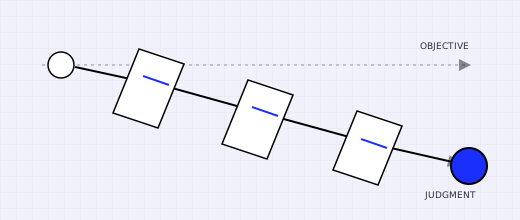
Cognitive biases are systematic, predictable patterns in human judgment that cause people to deviate from rational or objective thinking.
The idea
Human brains rely on mental shortcuts, or heuristics, to make fast decisions under uncertainty. These shortcuts are efficient but predictably distort judgment in the same direction across many people, producing biases: reasoning errors that repeat rather than random noise. Charlie Munger’s “Psychology of Human Misjudgment” catalogued around 25 such tendencies, and observed that biases rarely act alone; when several reinforce each other in the same direction, the combined effect can be far larger than any single bias.
When to use it
- Reviewing a decision before committing to it, to check which biases might be distorting the judgment
- Designing processes, incentives, or environments that account for predictable human error rather than assuming perfect rationality
- Understanding why groups and markets sometimes behave irrationally in a coordinated way
How to apply it
- Learn the individual biases, listed under Related models below, so they become recognizable in the moment
- Before a significant decision, run a short checklist of the biases most likely to apply, such as incentives, social proof, or recent events
- Seek an outside view or a person with no stake in the outcome to counter self-serving biases
- Watch for multiple biases compounding in the same direction — that combination is the most dangerous case
Watch out for
- Knowing about biases does not make you immune to them; awareness alone is a weak defense
- Labeling someone else’s reasoning as “biased” can itself become a rhetorical weapon
- Biases interact; treating them as isolated effects underestimates their real-world impact
Related models
- Lollapalooza — what happens when several biases combine and reinforce each other
- Social Proof — one of the most common biases in group settings
- Authority-Misinfluence — deferring to authority beyond what the evidence supports
- Over-Optimism — the tendency to overestimate favorable outcomes
- Availability-Misweighing — overweighting information that comes easily to mind
- Contrast Misreaction — judging things relative to a recent reference point rather than in absolute terms
Sources
Charlie Munger, “The Psychology of Human Misjudgment” (speech, 1995, later published in Poor Charlie’s Almanack); Daniel Kahneman, Thinking, Fast and Slow (2011).