Availability Misweighing
Open full-size illustration →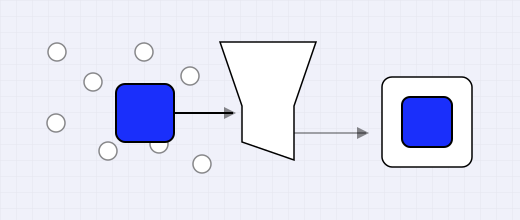
Availability-misweighing tendency is Charlie Munger’s term for overweighting information that is vivid, recent, or easily recalled, while underweighting information that is just as important but harder to bring to mind.
The idea
The mind treats ease of recall as a proxy for importance or frequency. Dramatic, recent, or emotionally charged examples come to mind easily and get overweighted in judgment. Relevant but less available information gets ignored simply because it does not surface. That includes base rates, absent evidence, and silent failures.
In group settings this can snowball into an availability cascade. A simple explanation of a complex issue spreads because it is easy to repeat and picture. It gains apparent credibility from its own repetition rather than from evidence, even when it is wrong.
When to use it
Notice it when a single vivid anecdote or recent event is doing more work in your reasoning than the underlying statistics warrant.
How to apply it
Seek out the information that is not naturally available. Check base rates. Look for counterexamples. Ask what evidence would exist if the vivid case were the exception rather than the rule.
Watch out for
Media coverage and personal anecdotes make rare, dramatic events feel common, and they make common, undramatic risks feel rare. Combining availability-misweighing with a habit of only seeking confirming evidence compounds the error.
Related models
- Authority Misinfluence. A related Munger misjudgment tendency, and a common source of cascades.
- Probabilistic Thinking. A corrective habit of reasoning in base rates rather than vivid cases.
- Cognitive Biases. The broader category this tendency belongs to.
Sources
Charlie Munger, “The Psychology of Human Misjudgment” (speech, 1995). The availability cascade is discussed further in Shane Parrish’s Farnam Street mental models guide and in writing on cognitive tendencies by Michael Simmons and Ian Chew.