7 Levels of System Intervention
Open full-size illustration →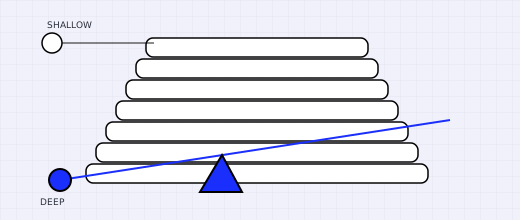
Not every way of intervening in a system has the same power. Some levers are easy to pull but barely move outcomes; others are hard to pull but change what the system does at its root.
The idea
Systems thinking distinguishes shallow interventions from deep ones. A shallow intervention adjusts a parameter, a number, or a budget. A deep intervention changes the rules, the information and feedback flows, the goal the system is organized around, or the mindset that produced the system. Tweaking a number rarely changes behavior for long, because the system’s structure and goals stay the same. Changing the goal, the feedback loops, or the rules changes what the system optimizes for. Donella Meadows’ essay on leverage points ranks a dozen types of intervention from weakest to strongest. Shorter summaries of her work often condense the list into a handful of practical levels.
When to use it
- Diagnosing why a fix keeps not working, or keeps being undone.
- Deciding where to spend limited effort in a stuck team, process, or organization.
How to apply it
- Name the system and the behavior you want to change.
- List every lever available, from adjusting a number up to changing the goal or the mindset behind the system.
- Sort the levers from shallow to deep.
- Check whether a deeper lever is realistically available before settling for a shallow one.
Watch out for
- Shallow interventions feel fast but rarely stick, because the structure producing the problem is untouched.
- Deep interventions, such as goals and mindsets, are slower and harder to get agreement on. Depth and difficulty tend to move together.
Related models
- Feedback loop. One of the deeper leverage points this model draws on.
- Root cause analysis. A complementary way of finding where to intervene.
- Bottleneck. A shallower, more localized point of intervention.
Sources
Donella Meadows, “Leverage Points: Places to Intervene in a System” (1999).